



ACCELERATING YOUR TRAVEL

ThrustMotion Takes Public Transport Hypersonic

The world’s leading transportation company, ThrustMotion, partners with Sunk Capital for a boost of $1.2tn in funding to expand its network of alternative travel solutions powered by unproven experimental technology. 

147Million customers

Powering millions of daily commutes.

15%Accident rate

A gradually improving safety record.

2Keystone projects

Disrupting safe, conventional travel

Bringing people and places together at high-hypersonic velocities

ThrustMotion is a major player in the global transport sector, serving millions of customers each year with its revolutionary approach to innovation. Founded in 2020 by Indian hat merchant, Arjun Sharma, after inheriting his wealth from a distant relative, ThrustMotion have pioneered the use of untested, experimental technology in public transportation.

The leading principle by which ThrustMotion operates is simple: velocity by any means. When working people across the world want to commute faster in order to spend more time with loved ones and hobbies, steady, safety-driven innovation becomes a barrier to progress.

With two keystone projects already well into Phase One trials in several major cities around the world, Sunk Capital have invested at just the right time to catapult both ThrustMotion shareholders and customers into a brighter, faster future,.

Company timeline

12February1974

A bright career begins

Arjun Sharma begins his career as a roadside hat merchant in rural India.

22June2017

A helping hand

Sharma's distant fourth half-cousin, six times removed, Deepika Padukone, leaves her entire estate, some $27bn, to Sharma due to an administration error.

11April2018

ThrustMotion is born

Sharma founds ThrustMotion on a dare from a friend after a bar fight in the suburbs of Bengaluru. Commits his entire fortune.

9November2021

Zero-Friction Hydro Loop launches

ThrustMotion's first project, the Z-FHL, launches in India, followed by intercity networks in France, UK, Belgium, Germany and Bangladesh.

7October2025

Partnership with Sunk Capital

After exhausting his fortune and accumulating significant debt, Sharma asks Sunk Capital to step in as partners.

A single journey to reshape the journey of millions

Arjun Sharma is known as both a visionary leader and a significant debtor in the transportation sector. ThrustMotion’s first keystone project, the Zero-Friction Hydro Loop, has been touted by industry experts as “an appalling waste of resources” and “not just logistically unsound, but genuinely dangerous”.

Sharma has never been a man to listen to his critics, even if they sit on transportation safety boards in countries that ThrustMotion operate in. It is this fearlessness that attracted the investment of Sunk Capital. At $1.2tn, this is one of the largest single investments in the history of the company.

Keystone Project #1: The Zero-Friction Hydro Loop (Z-FHL)

When Arjun Sharma was a young man selling hats by the roadside in rural India, he accidentally fell into a narrow pipe filled with stagnant water. After being trapped in terrifying isolation, Sharma had to inch his way to the end of the pipe, some half a mile distant, before being rescued seven hours later. His ordeal gave him the perfect idea for a new way to get from A to B—confined pipes filled with liquid.

In 2017, when Sharma inherited his fortune, this dream would soon become a reality. ThrustMotion was founded and the first prototype of his new travel technology was tested. While no volunteers survived the initial trials, the technology took a dramatic leap forward with the hiring of ThrustMotion’s first Chief Scientist, a disgraced weapons chemist named Amit Das.

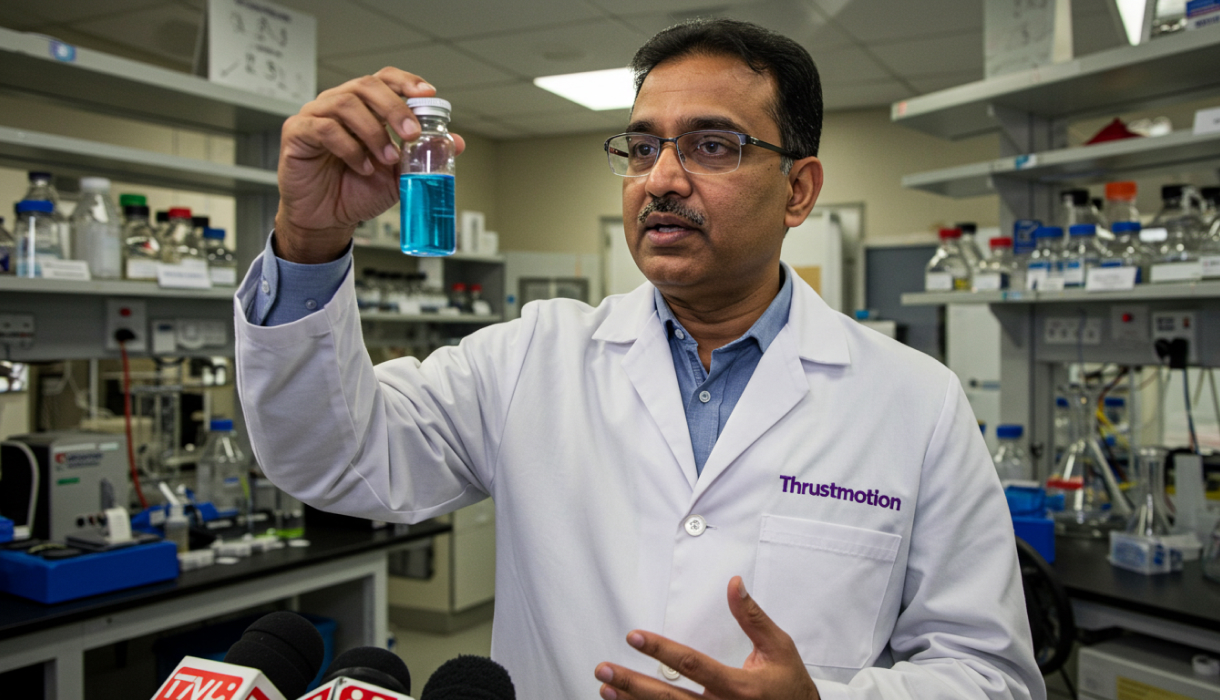
ThrustMotion Chief Scientist, Amit Das, holds up a vial of blue liquid in a laboratory setting
ThrustMotion Chief Scientist, Amit Das, holds up a vial of MachGel™

MachGel™: The revolutionary fluid powering the Z-FHL

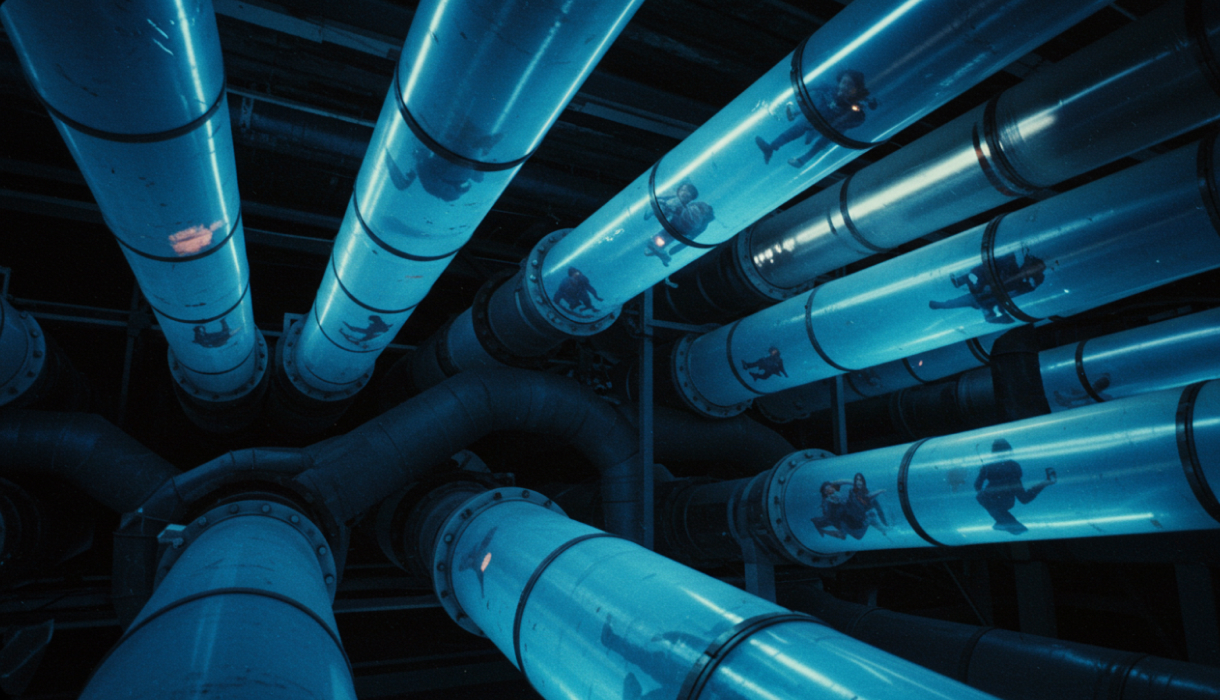
The core principle of the Z-FHL is a series of underground pipes—termed Inertial Dampened Glide-Ducts (IDGD)—that carry humans at high-velocity between intercity travel hubs. Commuters are immersed in a blue fluid pioneered by ThrustMotion that allows for an average speed in the Glide-Ducts of 352m/s, or just over Mach 1.

After two years of trials with extremely low rates of success, Das accidentally arrived at a formula which, in addition to reducing friction to almost zero, makes MachGel™ fully breathable. It is also mostly edible, providing a nutrient-rich substance during travel. MachGel™ simultaneously disinfects and sterilises any waste material in the system. 

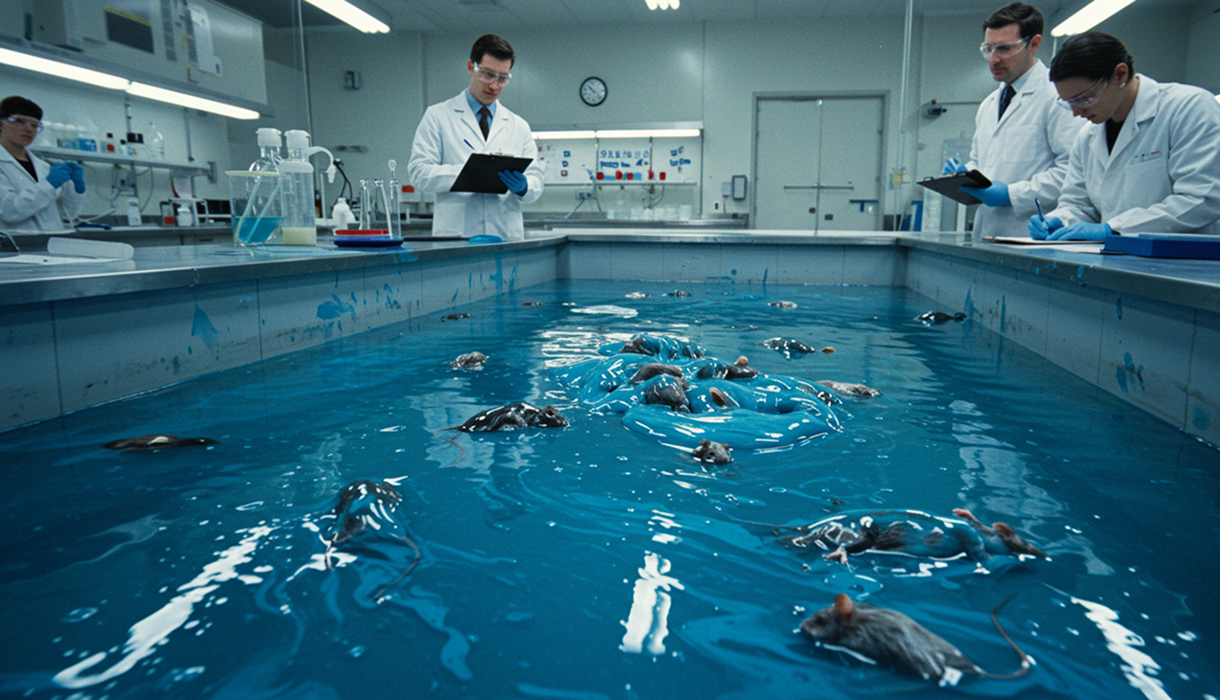
Dead mice floating in a pool of blue slime surrounded by scientists wth clipboards
Early MachGel™ trials on mice were only a partial catastrophic failure.
The Zero-Friction Hydro Loop network

An underground section of the Z-FHL, showing multiple Glide-Duct routes beneath the streets of Berlin, Germany.

The first ZFHL launches, commuters cut journey times by 98.92%

The first Z-FHL network opened in Bengaluru, India, in late 2021. After massive cost overruns and a considerable number of “alleged” fatalities, the first successful commute was undertaken from one end of the city to the other, a total distance of 47km. The record-breaking journey took just 2 minutes and 14 seconds.

Compared to an average commute by bus at peak traffic times of 3 hours and 27 minutes, this represents a reduction of 98.92%. The early success of the Z-FHL was carried over into the German market, thanks to generous government tax breaks for low-emission travel projects.

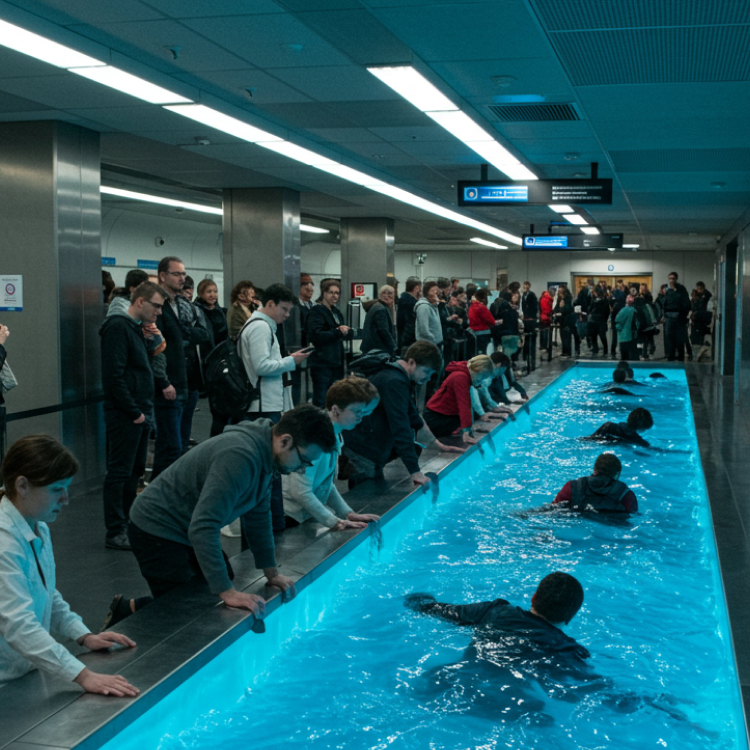
Commuters entering a pipe network filled with blue fluid.
Commuters entering the Z-FHL system at a transport hub in Berlin, Germany.
ThrustMotion engineers maintaining a section of the Z-FHL.
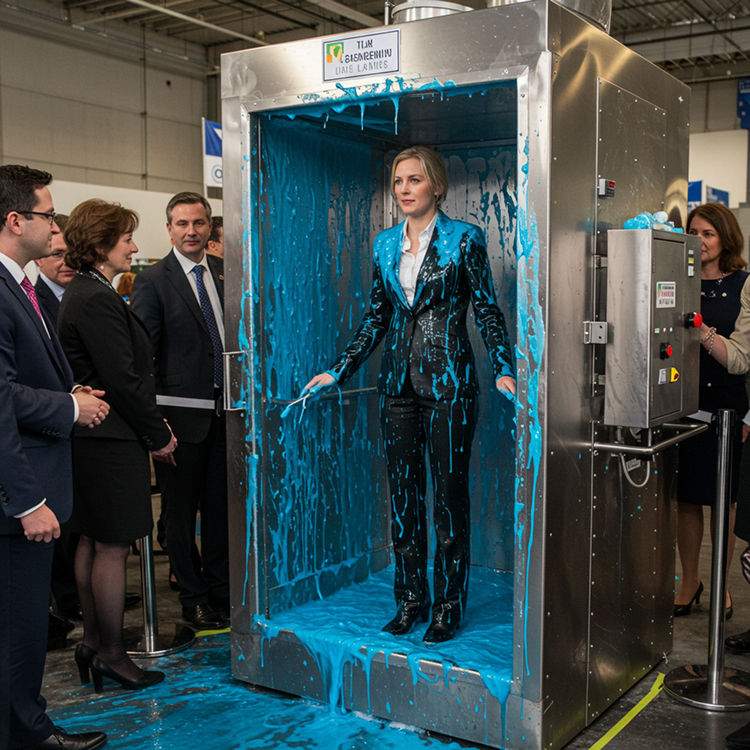
A woman covered in blue slime inside a steel industrial dryer.
A commuter uses a ThrustMotion blast dryer at the end of her journey.

Investment to take low-friction tube-based travel global

This major investment from Sunk Capital will enable ThrustMotion to expand Z-FHL networks into all major cities worldwide, beginning with European capitals. It has taken a considerable number of bribes to circumvent safety regulation, and permission has already been granted for extensive, nation-wide Z-FHL networks in both France and Spain.

One of the key mechanisms to speeding up construction is to rely on the mass production of glide-ducts by untraceable shadow companies. While the workmanship is considered substantially below standards for basic structural integrity, the increase in production volume is considered more than worth the trade-off.

An Indian woman giving an interview to the press covered in blue slime
An early Z-FHL commuter in India gives her reactions to the press.
A transit hub station covered in blue slime that has had a major accident

Some small service interruptions are known to occur on the ZFHL network, although these are only moderately common.

Keystone Project #2: The International Railgun Network (IRN)

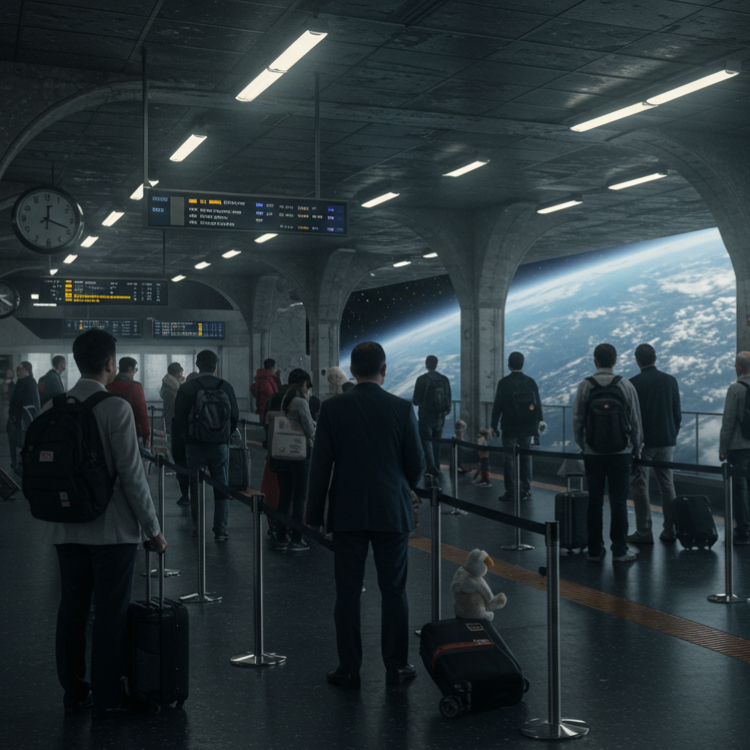
While the revolutionary Z-FHL allows commuters to travel at speeds of up to Mach 1, ThrustMotion have already launched a second keystone project that takes a speedy commute to high-hypersonic levels.

The International Railgun Network (IRN) has one goal in mind: to make any destination on Earth reachable within one hour. The IRN works by firing a rolled-tungsten transportation projectile at a velocity of 9.5km/s (~Mach 28) toward an orbital relay station. The projectile is then rapidly decelerated using a powerful magnetic field. Once aboard the relay station, then can either be fired back down to their destination on Earth or, if their destination is not within reach, travel between orbital stations by in-orbit railguns.

A typical journey from a ground-based railgun to an orbital relay is a flight time of just 42 seconds. While the initial launch can be somewhat uncomfortable, pulling ~14,788 Gs. THe orbital relay station deceleration has a momentary spike of 477,891 Gs as the projectile is brought to an almost instantaneous stop.

A man boarding a steel shell to be launched to low earth orbit
Boarding a rolled-tungsten transport pod at the IRN station in Paris.
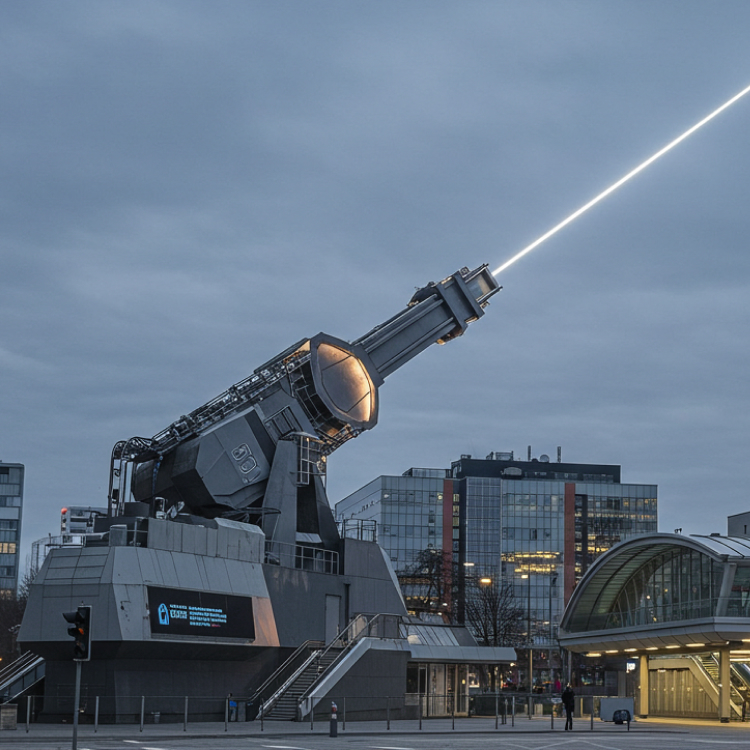
Railgun shown above a transport hub

A railgun and boarding hub, part of the International Railgun Network (IRN) of high-hypersonic commuting

Unlocking global travel for millions

There are 92 orbital relay stations planned, with 28 currently complete. This will give full coverage of the global for the IRN, at the small price of massive ongoing disruption to the space and satellite industries. While costs to use the IRN are currently a little higher than expected, at around $11.2m per one-way ticket, there is a 15% discount available for pre-booked tickets with an open return.

There are two current challenges for the IRN that need to be solved. The first is the gargantuan amount of energy required to fire each railgun—2 terawatts (or two trillion watts). Over the 1.5 second duration of the launch, each shot uses the same amount of energy as the entirety of Norway. The second challenge is the railgun barrels which, due to the extreme forces of each launch, last for around 50 launches before complete structural failure.

Upcoming projects from ThrustMotion

Not content with Mach 28 travel with the IRN, ThrustMotion has already begun preliminary construction work on a project to make vehicular travel between continents easier than ever before. The Deep-Core Transit System (D-CTS) is designed to create roads directly through the Earth’s crust and into the inner mantle.

The first planned road will be between London, UK, and Santiago, Chile. It will run 10,119km long, saving 1,566km over a surface-level road. The depth is expected to reach 2,496km, just above the Earth’s liquid outer core, where the pressure exceeds 120 GPa (gigapascals), or roughly the same as stacking 4,920 of the largest cruise liners onto a single square meter.

ThrustMotion engineers are currently working on solving these minor issues and expect the first borehole to be drilled in early 2026.

Construction and excavation vehicles working deep underground by the Earth's inner mantle
Construction work on the Deep-core Transit System has already begun.

Reinventing modern travel together

With this new round of investment from Sunk Capital, ThrustMotion are poised to deliver the next-generation of commuting technologies. With an eye already on commercial freight and the transportation of vehicles directly, the future looks extremely bright for Arjun Sharma and his team of thinkers and innovators.

On the back of crippling levels of debt and numerous health and safety violations, ThrustMotion are preparing to rapidly expand their legal team in order to stem the incoming wave of serious injury and wrongful death lawsuits. 

Thrustmotion logo on a deep purple background

ThrustMotion FAQs

  1. Why do my energy costs keep going up?

    There is no single reason for this. A complex array of profiteering, corporate greed and the relentless march of late-stage capitalism are mostly to blame, as are our admittedly extortionate prices. We rely on our profits to pay out unreasonably large bonuses for our executives, and without passing many of our inflated costs on to you, our valued customer, Dypvann executives would miss out on vast sums of cash they likely don't need.

  2. How do I file a complaint with Dypvann?

    All complaints can be sent to our unmonitored customer support email address, available on our corporate website, which is not accessible to the public. We greatly value your feedback.

  3. Are all your facilities in Norway?

    No. We have facilities all around the world, mostly in the few countries that we are legally allowed to operate in. Our operations are heavily penalised in Norway due to "environmental negligence", which we greatly dispute. We allegedly have 14 illegal facilities on mainland Norway which have so far eluded government-mandated shutdowns, and six facilities offshore of Norway in locations so close to international water that responsibility for their operation is currently a grey area under current litigation. We cannot comment on this any further.

Related news